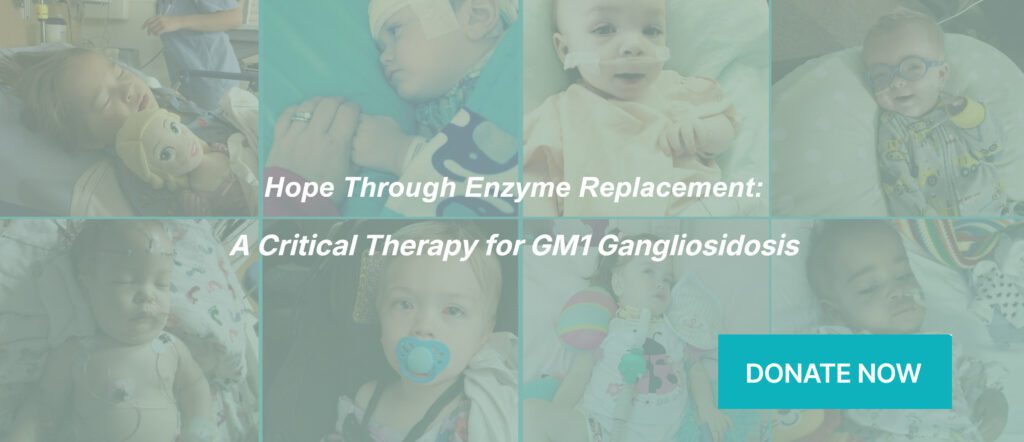
Cure GM1 is advancing enzyme replacement therapy for GM1 gangliosidosis. GM1 gangliosidosis is a rare, inherited lysosomal storage disorder. A mutation in the GLB1 gene reduces or eliminates beta-galactosidase, an enzyme cells need to clear a toxic fatty waste product. Without it, a substance called GM1 ganglioside builds up in the brain and organs and causes progressive damage. This project is moving an investigational ERT program through the manufacturing, regulatory, and clinical steps required for human trials.
WHY ENZYME REPLACEMENT THERAPY (ERT) FOR GM1 GANGLIOSIDOSIS?
Developing enzyme replacement therapy for GM1 – a vital missing piece in treating this fatal disease

Several treatments for GM1 are in clinical trials, but none has been approved. Each approach has limits.
AAV gene therapy appears to require earlier intervention than other approaches. Most children with GM1 are diagnosed after the optimal treatment window.
Small molecule drugs reduce ganglioside buildup, but most only work when some enzyme activity remains. They cannot help children with the most severe form of GM1, who have almost no functional enzyme at all.
ERT works differently. It delivers the missing enzyme directly, without relying on any existing enzyme activity. We believe ERT can help the majority of GM1 patients, including those who cannot benefit from other approaches.
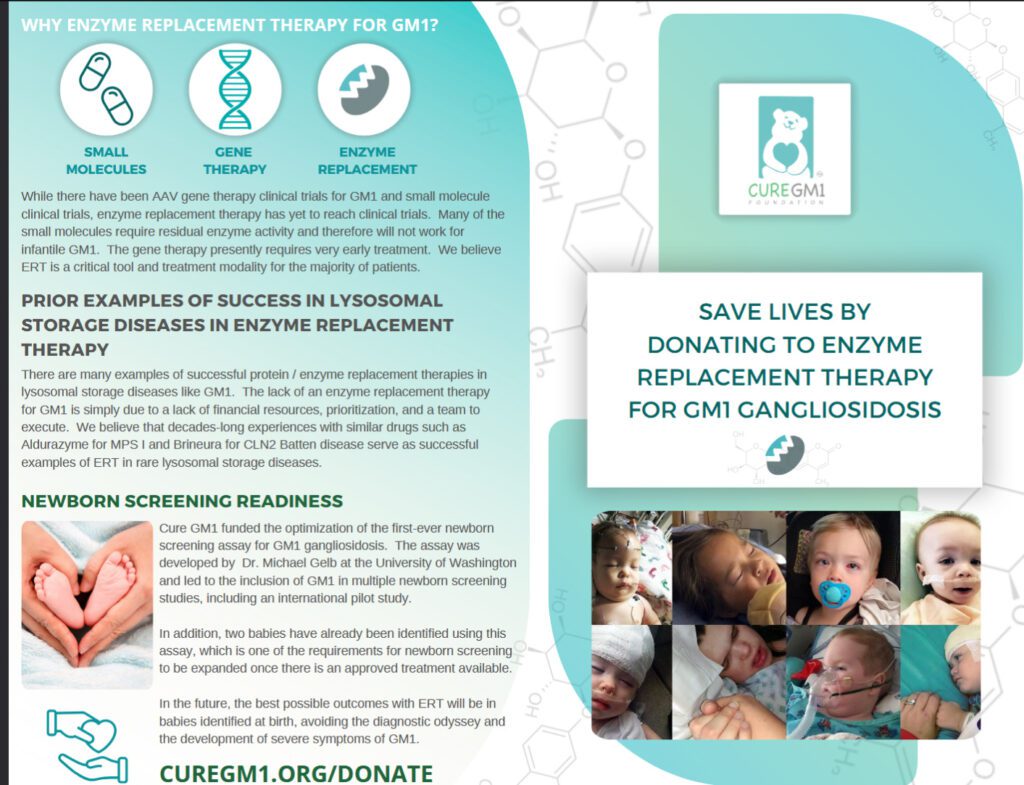
PRIOR EXAMPLES OF SUCCESS IN LYSOSOMAL STORAGE DISEASES IN ENZYME REPLACEMENT THERAPY
ERT is not new. It has already transformed outcomes in other lysosomal storage diseases. Aldurazyme (approved for MPS I) and Brineura (approved for CLN2 Batten disease) are successful examples of enzyme replacement therapy in rare diseases biologically similar to GM1. The science is well-understood. What GM1 has lacked is dedicated funding, prioritization, and an experienced team. That team is now in place.
NEWBORN SCREENING READINESS
Cure GM1 funded the first newborn screening assay for GM1, developed by Dr. Michael Gelb at the University of Washington. This assay is now included in multiple pilot programs worldwide, and it has already identified two affected babies before symptoms appeared.
Early identification is critical for ERT. The best outcomes come when treatment begins before neurological damage accumulates. Once ERT is approved, newborn screening creates the pathway to treat children in their first days of life. Researchers are also exploring whether ERT could eventually be administered before birth.

ERT AND THE TREATMENT LANDSCAPE
Some therapies require residual enzyme activity. Others are only effective early in the disease course.
ERT fills a critical gap. It can potentially help patients at any stage and any age, including those who are ineligible for gene therapy or small molecule drugs. Developing ERT means that more families have a real option, and that future combination therapies become possible.
TREATMENT APPROACHES COMPARED
Current therapeutic approaches for GM1 gangliosidosis each have distinct advantages and limitations. They all have value, and ultimately, combination therapies may provide the best outcomes for patients.
Enzyme Replacement Therapy offers several unique advantages. It can potentially help patients across all age groups and disease stages by directly supplying the missing enzyme. The planned intracerebroventricular (ICV) administration delivers the enzyme directly to the central nervous system where it’s most needed. Additionally, ERT has decades of precedent in similar disorders, making the development pathway more established.
Several AAV-based gene therapy trials have shown promise, as they aim to deliver functional copies of the GLB1 gene to cells. However, current approaches require very early intervention before significant neurological damage occurs. The treatment window is narrow, and many children are diagnosed too late to receive maximum benefit.
Drugs like venglustat work by reducing substrate / waste in the cell, but many require residual enzyme activity to be effective. This means they often cannot help children with infantile GM1 who have no enzyme function. While these medications are taken orally, making administration simpler, their limited efficacy for the most severe cases represents a significant drawback.
WE AIM TO RAISE $5M MORE TO MOVE FORWARD
Save lives by donating to Enzyme Replacement Therapy for GM1 gangliosidosis Your Support Makes a Difference
PILLARS OF DRUG DEVELOPMENT FOR GM1
Since the creation of Cure GM1 in 2015, we have been assembling building blocks to be able to support the drug development process and to improve the likelihood of success for GM1 research and clinical trials.

COMMUNITY
To attract interest from biotech companies to invest in treatments, we as a community must show we exist. More importantly, we must support each other.

ANIMAL MODELS
Cure GM1 partnered with the Jackson Laboratory to create the first publicly available mouse models in the history of GM1.
REGULATORY INTERACTIONS

EXTERNALLY-LED PATIENT-FOCUSED DRUG DEVELOPMENT MEETING
Cure GM1 organized the first-ever externally-led patient-focused drug development meeting with FDA and published the Voice of the Patient report published on the FDA website.

ACCELERATED APPROVAL BASED ON BIOMARKERS
In partnership with other patient advocates and groups, Cure GM1 met with regulators to champion change for ultra-rare diseases to encourage accelerated approval based on biomarkers. Currently, Cure GM1 is supporting multiple initiatives on this topic. You can see Act for Ultrarare for more information.
REAL-WORLD EVIDENCE NATURAL HISTORY, DATA SHARING aND BIOBANK
In order to support drug development and research, Cure GM1 has multiple initiatives that support research and drug development. Families can participate in these efforts to ensure that GM1 is research-ready! Learn more about our Data Sharing Initiative.


OUR ENZYME REPLACEMENT THERAPY TEAM
Cure GM1 has built a team of advisors and volunteers with decades of prior experience in protein / enzyme replacement therapies. Both Paul and Gouri have prior experience working on GM1 drug development and research. As the project advances, we will also add our regulatory and clinical advisors to the project.


Gouri Yogalingam, PhD
Scientific Advisor

Paul Fitzpatrick, PhD
CMC and Scientific Advisor

Chris Phillips, MS
CMC Advisor

Sanjay Ahuja, PhD
Regulatory Advisor

Your Donation Can Save Lives
Watch our family videos and learn more about what it is to live with GM1.
Every dollar goes directly toward the science: lab work, manufacturing development, and regulatory preparation. Our current goal is $4 million to reach our IND filing, the milestone that opens the door to clinical trials in humans.
Children with GM1 cannot wait. Every day without treatment means irreversible neurological damage. Your gift today brings the first GM1 enzyme replacement therapy one step closer.
There are Multiple Ways You Can Make an Impact
- Monthly Giving
- Corporate Matching
- Family Fundraising
- Spread Awareness
- Legacy Giving
- Gifts of Stock
- Crypto
- Paypal Giving Fund
Questions About GM1 Enzyme Replacement Therapy
What is GM1 gangliosidosis?
GM1 gangliosidosis is an inherited lysosomal storage disorder caused by changes in the GLB1 gene. These changes reduce beta-galactosidase activity, allowing GM1 ganglioside and related substances to build up in cells, especially in the brain and nervous system.
What is enzyme replacement therapy for GM1?
Enzyme replacement therapy, or ERT, is a treatment strategy designed to supply the missing or deficient enzyme. For GM1 gangliosidosis, Cure GM1 is focused on advancing an investigational beta-galactosidase replacement approach as part of a broader treatment landscape.
Is enzyme replacement therapy approved for GM1?
There is not yet an approved enzyme replacement therapy for GM1 gangliosidosis. Cure GM1’s project is intended to help move ERT research through the preclinical, manufacturing, and regulatory work needed to prepare for clinical trials.
How do donations support GM1 ERT research?
Donations help fund laboratory work, manufacturing development, regulatory preparation, and clinical readiness for the enzyme replacement therapy program. Each gift supports the steps needed to move GM1 research closer to a possible treatment option.