
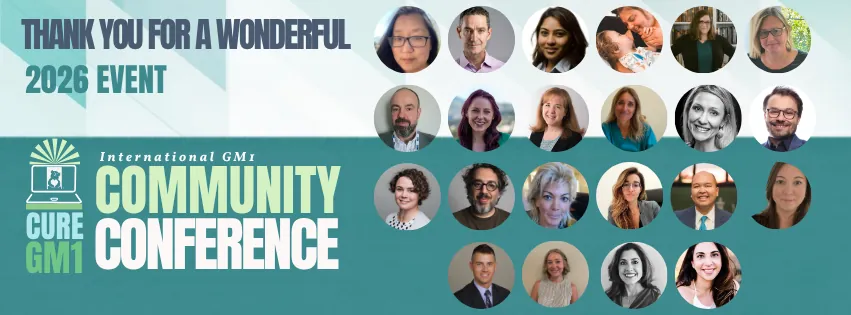
On Friday, October 2, 2026, families, clinicians, researchers and advocates from around the world gathered online for the International GM1 Virtual Community Conference. Over one day and four blocks of sessions, we heard from parents, scientists running clinical trials, and specialists in everything from communication devices to special needs trusts.
GM1 comes without warning, without asking. And somehow it led each of us to a virtual room full of people who understand, without anything needing to be explained. As we said in the welcome, “The research matters enormously, but the people you meet today may be the ones you call at 2 a.m. with questions next year. We are rare, and today we are not alone.”
Here are some of the moments that stayed with us.
Families opened the day
The conference began where it belongs, with families. In our Family Speaker Series, two mothers shared their stories.
Varuna Gopalan spoke about her son Kiaan, who has juvenile GM1. She described a hope that does not depend on knowing the future: “Hope is loving Kiaan exactly the way he is today.” She also had a message for everyone working on the science: “Thank you for refusing to accept that no treatment is the end of the story.”
Amber shared the story of her son Daxton, who had infantile GM1 and passed away in October 2025. “When I say the words ‘infantile GM1,’ I know some people hear the name of a rare disease, but when I hear those words, I hear my son’s name.” She spoke honestly about how few resources were available, including no local pediatric hospice or palliative care, and about what parents do when the system falls short: “When the system doesn’t have an answer, us as parents, we become the answer.”
We also looked back with Dr. Jeanine Jarnes of the University of Minnesota, who has known the GM1 community for more than a decade. When she first met our family, there were no clinical trials for GM1 or GM2 gangliosidosis. “The biggest difference, to me, is we now have some therapies in clinical trial. We still don’t have an efficacious therapy approved,” she said, and she gave the credit to the families who enrolled in natural history studies and trials.
A brighter blueprint for advocacy
In her keynote, “It Doesn’t Have to Be This Way,” advocate Lesa Brackbill drew on her family’s experience and her work bringing Krabbe newborn screening to Pennsylvania. Her central idea was a hopeful one: “Systems aren’t actually broken… they’re performing exactly as they were designed. That should be encouraging, because that means that if they were designed, they can be redesigned.”
She encouraged families to use their stories strategically alongside data, to illustrate gaps that numbers alone can’t explain. And she reminded caregivers to protect their own stamina: “Rest and joy are structural requirements for long-term advocacy and caregiving, not luxuries.”
The Foundation’s work, and how you can help
In our foundation update, we talked about hope, community, awareness and advocacy. Hope is not a prediction, but a belief that there is work in front of us worth doing today. And for a disease this rare, community is not just inspiration. “That is arithmetic. No single family has enough data to move a regulator. No single family can fund a therapy by themselves.”
Two programs are at the center of that work right now:
- The GM1 Matrix. Launched this year in collaboration with Combined Brain, the Matrix is a secure, IRB-approved portal where families complete surveys and share medical records. Researchers see anonymized data, not your child’s name. Natural history data like this may one day allow trials to compare treated children against existing data, rather than asking families to accept a placebo arm. “Filling out a survey on a Tuesday night is not just paperwork.”
- ICV enzyme replacement therapy (ERT). ICV ERT delivers the missing enzyme into the fluid around the brain. Enzyme replacement is a proven approach in other lysosomal diseases, and it may help children who can’t benefit from other options, such as those with no residual enzyme or with antibodies to gene therapy vectors. We held our INTERACT meeting with the FDA in July 2026. The next step is a pre-IND meeting, followed by IND-enabling studies. Funds from this year’s Do It for GM1 campaign are helping move this work forward.
We also emphasized that different approaches are not in competition. “A newborn picked up on screening and a teenager who’s been living with GM1 for a decade are not the same medical problem… Every arrow in the quiver matters.”
Fighting like a mother
Our second keynote came from Amber Freed, founder and CEO of SLC6A1 Connect, in a talk titled “Fighting Like a Mother.” In 2018, her son Maxwell was diagnosed at 18 months old with SLC6A1, a rare genetic condition that causes developmental delays, epilepsy, and cognitive and motor challenges. With no treatments available, Amber left her career in equity research to pursue one.
Through SLC6A1 Connect, she raised philanthropic funding, built scientific and patient infrastructure, and formed partnerships with academic, clinical and industry teams. In 2025, Maxwell became the first person in the world to receive an experimental gene therapy for SLC6A1.
Amber’s story shows what a determined parent-led organization can set in motion. She spoke to GM1 families as a fellow rare disease mother, with a message about finding community and holding on to hope for the future.
Research moving on many fronts
As Cure GM1 board member Joshua Henderson put it, “research for GM1 is moving on many fronts at once: in the lab, in the clinic, in tools that families are using every day.” None of the therapies below is approved for GM1, and each speaker was careful to separate early signals from proof. Here is where things stand.
In the clinic
- Nizubaglustat (Azafaros). Christian Freitag shared an update on NAVIGATE, the phase 3 trial that includes GM1 and GM2 gangliosidosis. Enrollment closed with just over 80 patients, above the planned 75, which he said reflects the high unmet need. Patients are randomized 2:1 to drug or placebo, and everyone can roll over onto the drug at the end of the study. Natural history data helped shape the trial’s design.
- Prenatal gene therapy (UCSF). Emma Canepa described a first-in-human phase 1/2 trial of AAV gene therapy given before birth, which recently received FDA clearance to proceed. Treating early may matter because damage can begin before birth, and the blood-brain barrier is more permeable during development. The trial’s main goals are safety and feasibility. The team covers travel and relocation for eligible families and invited the community to share its views on the protocol.
- Acetylleucine. Dr. Caroline Hastings of UCSF explained why a drug studied in Niemann-Pick type C and GM2 may be relevant to GM1, since these diseases share biology. She was clear that “at this time we do not have published data on its use in humans with GM1 gangliosidosis.” The FDA-approved form, Aqneursa, is approved for Niemann-Pick type C, so use in GM1 would be off label and is a decision for families and their physicians.
- Venglustat. Dr. Jeanine Jarnes reviewed the AMETHIST study, which included seven children with juvenile GM1. Over two years, GM1 ganglioside in their spinal fluid fell by 29.1 percent, and the children’s condition remained relatively stable, though there was no placebo group for comparison.
In the lab
- Stem cell gene therapy (SR-Tiget, Milan). Dr. Maria Ester Bernardo described how a patient’s own blood stem cells can be given a working copy of a gene and returned, turning them into “enzyme factories.” Her team is building a platform approach for several lysosomal diseases. If approved, a platform trial could open around mid-2027, with an arm for GLB1-related disorders, including GM1, added after the first group.
- A stronger enzyme (University of Padova). Dr. Valentina Poletti presented the “Padua variant,” a lab-evolved, hyperactive version of the beta-galactosidase enzyme. In GM1 mice, stem cell gene therapy showed benefit, though correction was partial, and the new enzyme aims to improve on that.
- Personalized medicine (Chapman University). Dr. Allisandra Rha explained why a child’s specific GLB1 variants may affect how well a therapy works, and how cerebral organoids, “a little mini brain in a dish,” may someday help guide treatment decisions. Gene editing “isn’t quite at the point where we can use it for GM1 yet,” she said, but preclinical work is ongoing.
- A safer AI for families (Basion.ai). Mohsen Hejrati introduced an AI agent built with input from GM1 families to help organize medical records and research, designed with consent built in and a commitment that patient data is never sold.
Practical help for caregivers
The final block, opened by Cure GM1 board member David Law, focused on daily life with GM1. These sessions were full of advice families can use right away.
- Supporting your partnership. Chrissy Salley spoke about how caring for a seriously ill child affects couples. Partners often cope and grieve in different ways, and “neither of these are wrong. They are just different styles of coping.” Her advice: name the problem out loud when there is conflict, and remember you can always talk with a neutral person, such as a therapist, chaplain or palliative care physician.
- Disability and special needs planning. Andre Sam walked through special needs trusts, guardianship at age 18, and US benefits like SSI and Medicaid. One key point for US families: GM1 gangliosidosis is on the Social Security Compassionate Allowances list, which can speed up disability benefit decisions. In his words, “It’s your Lightning Lane pass, right to the front of the line for benefits.” Rules vary by state, and his talk was informational, not legal advice.
- Communication at every stage. Kaitlyn Ober shared strategies for augmentative and alternative communication (AAC). Many people with juvenile GM1 keep strong understanding even as speech changes, so “there is no such thing as being too early to introduce AAC.” She suggested voice banking to preserve a person’s own voice, and modeling words throughout the day: “Communication is involved in every single thing we do.”
- Family planning and IVF. Genetic counselor Vanessa Rangel Miller explained IVF with preimplantation genetic testing (PGT-M), which tests embryos for a family’s known GLB1 changes. “There’s really no one single right choice for reproductive decision-making.” Parents Rojan Vakili and David Law then shared their own experiences. David offered a thought that resonated with many: “grief and joy, they’re not necessarily opposites, and oftentimes they do coexist.”
In the caregiver Q&A, parents traded advice on finding the right support group, using state resources, and leaning on families who have walked a similar path.
Looking ahead, together
Awareness work continues too. David Law shared that for the fourth year in a row, the California State Senate recognized GM1 Awareness Day on May 21, with State Senator Steve Padilla reading the declaration on the Senate floor.
In our closing remarks, we thanked everyone who showed up, including those who watched with a child on their lap or listened while handling a feeding or a medication schedule. To researchers and clinicians, we offered a reminder: “every data point is a child. Patients and families are the center of this work. Not off to the side, the center.” And to families: “we are not as powerless as we feel. Researchers can’t study what they can’t see.”
“None of us chose this community, but I’m so grateful for the people in it. You make the hard days a little lighter, and you make the hopeful days feel possible.”
How you can help
- Join the GM1 Matrix. Set up your clinical research ID, then share records and complete surveys at your own pace. Your family’s data helps shape future trials.
- Support ICV ERT and our research programs. Every gift, birthday fundraiser and event adds up. Donate to Cure GM1.
- Reach out. Whether your child was just diagnosed or you have been part of this community for years, we are here. Email us at info@curegm1.org.
Thank you to every speaker, moderator, sponsor, volunteer and family who made this year’s conference possible. We are rare, and we are not alone.